Object-Oriented Programming (OOP) is a programming paradigm that organizes software design around objects — instances of classes that bundle data and behavior together — rather than around functions and logic. IBPS SO IT Officer tests this subject almost entirely through comparisons: Encapsulation vs Abstraction, Overloading vs Overriding, Abstract Class vs Interface, and the four pillars themselves, rather than through writing or debugging code.
This guide is a single-page revision hub for OOPs Concepts in Java: concise definitions, comparison tables, and a priority order for what to study first, followed by topic-wise and full-length mock tests.
Topic Priority for Revision
Previous year papers show a consistent pattern in which OOPs topics get tested most. Use this single table to sequence your revision.
| Topic | Exam Weightage | Revise |
|---|---|---|
| Four Pillars of OOP | ⭐⭐⭐⭐⭐ | First |
| Class vs Object | ⭐⭐⭐⭐⭐ | First |
| Method Overloading vs Overriding | ⭐⭐⭐⭐⭐ | First |
| Abstract Class vs Interface | ⭐⭐⭐⭐☆ | Second |
| Procedural vs Object-Oriented Programming | ⭐⭐⭐⭐☆ | Second |
| Association, Aggregation & Composition | ⭐⭐⭐☆☆ | Second |
Constructors & this/super Keywords | ⭐⭐⭐☆☆ | Third |
| Static vs Dynamic Binding | ⭐⭐⭐☆☆ | Third |
Exam-day shortage of time? Cover every "First" row above, then Abstract Class vs Interface — together these account for the majority of OOPs questions in past IBPS SO IT Officer papers.
Start Your OOPs Concepts Revision
Revise the topics above, then reinforce them with subject-wise free mock tests built for the IBPS SO IT Officer exam.
1. What Is OOP? Procedural vs Object-Oriented Programming
Object-Oriented Programming organizes code around objects that combine data and the methods that operate on that data, in contrast to Procedural Programming, which organizes code around a sequence of functions operating on shared data.
| Procedural Programming | Object-Oriented Programming |
|---|---|
| Built around functions | Built around objects |
| Follows a top-down approach | Follows a bottom-up approach |
| Data is less secure (globally accessible) | Data is more secure (encapsulated within objects) |
| Difficult to reuse code across programs | High code reusability via inheritance |
| Example: C | Example: Java, C++, Python |
Q: Why is OOP considered more secure than procedural programming? A: OOP is more secure because Encapsulation restricts direct access to an object's internal data using access modifiers, whereas procedural programming typically allows any function to access and modify shared global data without restriction.
Quick Revision
- Procedural = function-centric, top-down, less secure, hard to reuse.
- OOP = object-centric, bottom-up, more secure, highly reusable via inheritance.
2. Class vs Object
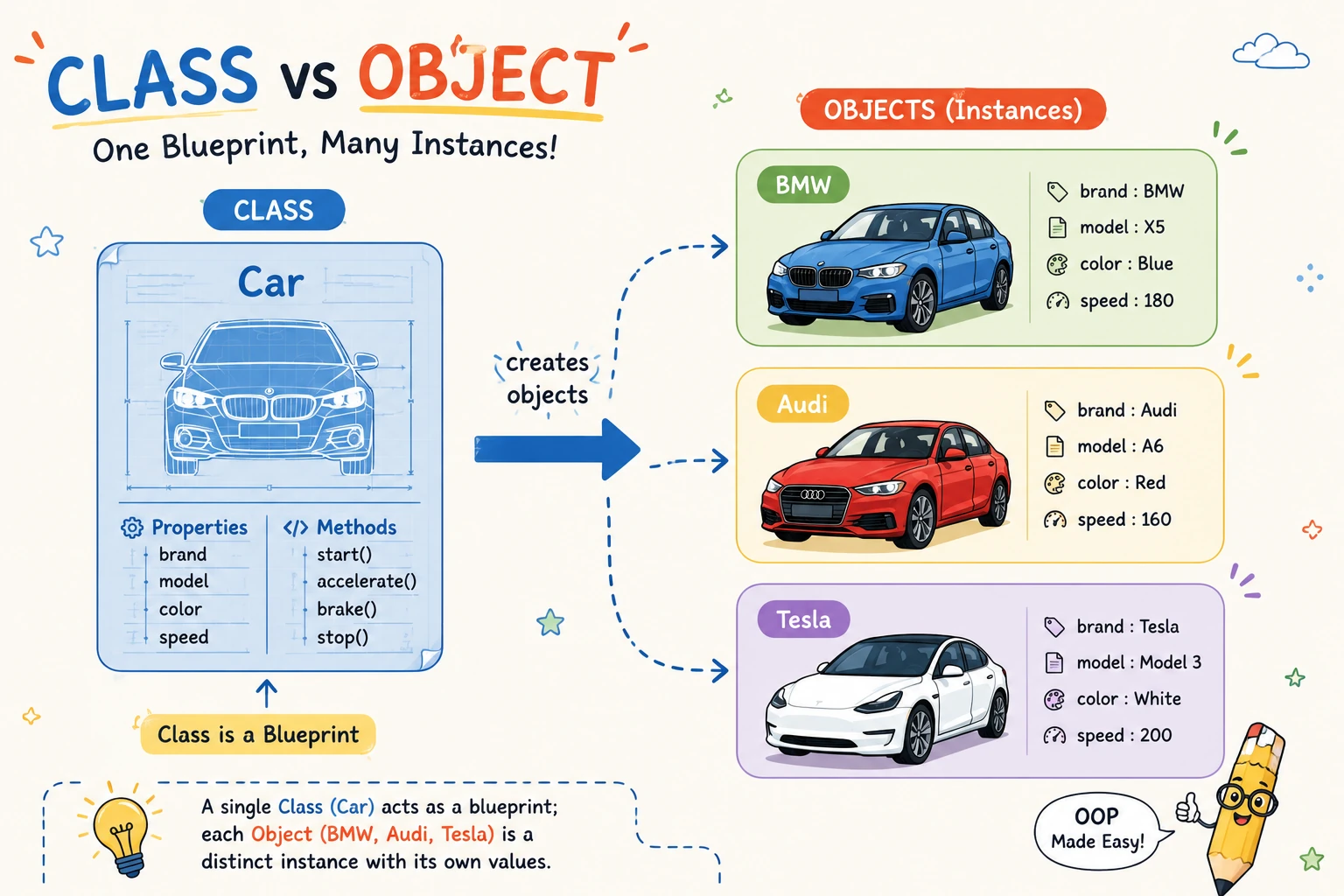
A Class is a logical blueprint that defines the properties and behaviors an entity should have, while an Object is an actual instance of that class, created in memory with real values assigned to those properties.
| Class | Object |
|---|---|
| A blueprint or template | An instance created from the class |
| A logical entity | A physical entity |
| Declared once | Multiple objects can be created |
| Does not occupy memory until instantiated | Occupies memory when created |
Q: What is the difference between a Class and an Object? A: A Class is a logical blueprint that defines the properties and behaviors an entity should have, while an Object is an actual instance of that class created in memory, with real values assigned to its properties.
Quick Revision
- Class = blueprint (logical, no memory until instantiated).
- Object = instance (physical, occupies memory).
- One class can produce many objects, each with independent property values.
3. The Four Pillars of OOP
The four pillars of OOP — Encapsulation, Abstraction, Inheritance, and Polymorphism — are the core principles that define how object-oriented languages model real-world entities as reusable, secure, and extensible code.
Encapsulation
Encapsulation binds data and the methods that operate on that data into a single unit (a class), restricting direct access to internal data using access modifiers like private.
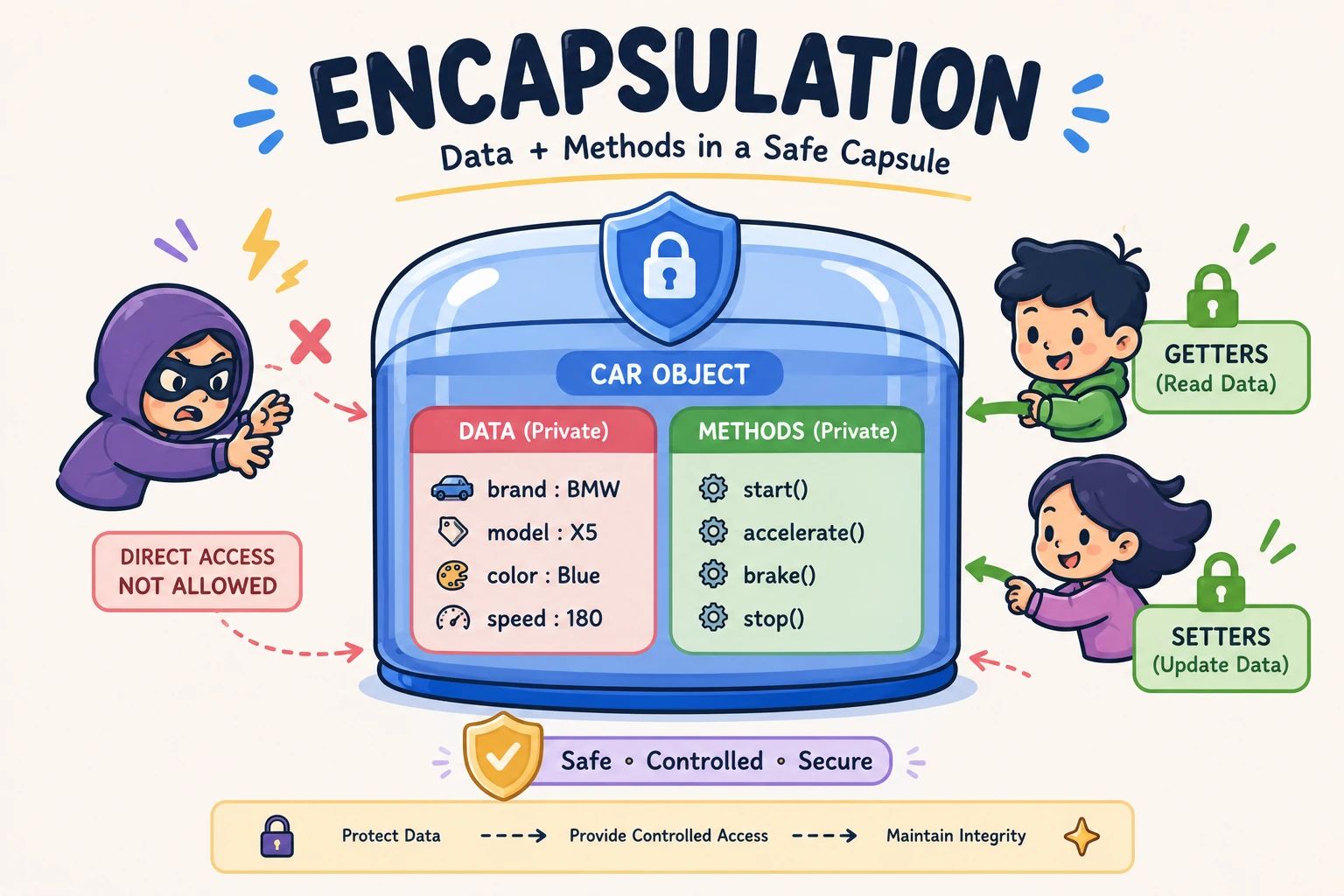
Common use: Private fields with public getter/setter methods to control how data is read or modified.
Abstraction
Abstraction hides the internal implementation complexity of a system and exposes only the essential features needed by the user.
Common use: Abstract classes and interfaces, where the user calls a method without knowing how it's implemented internally.
Q: What is the difference between Encapsulation and Abstraction? A: Encapsulation binds data and methods into a single unit and restricts direct access to internal data using access modifiers, focusing on how information is protected. Abstraction hides implementation complexity and exposes only essential features to the user, focusing on what is shown rather than how it works internally.
Inheritance
Inheritance allows a class (child/subclass) to acquire the properties and methods of another class (parent/superclass), enabling code reuse.
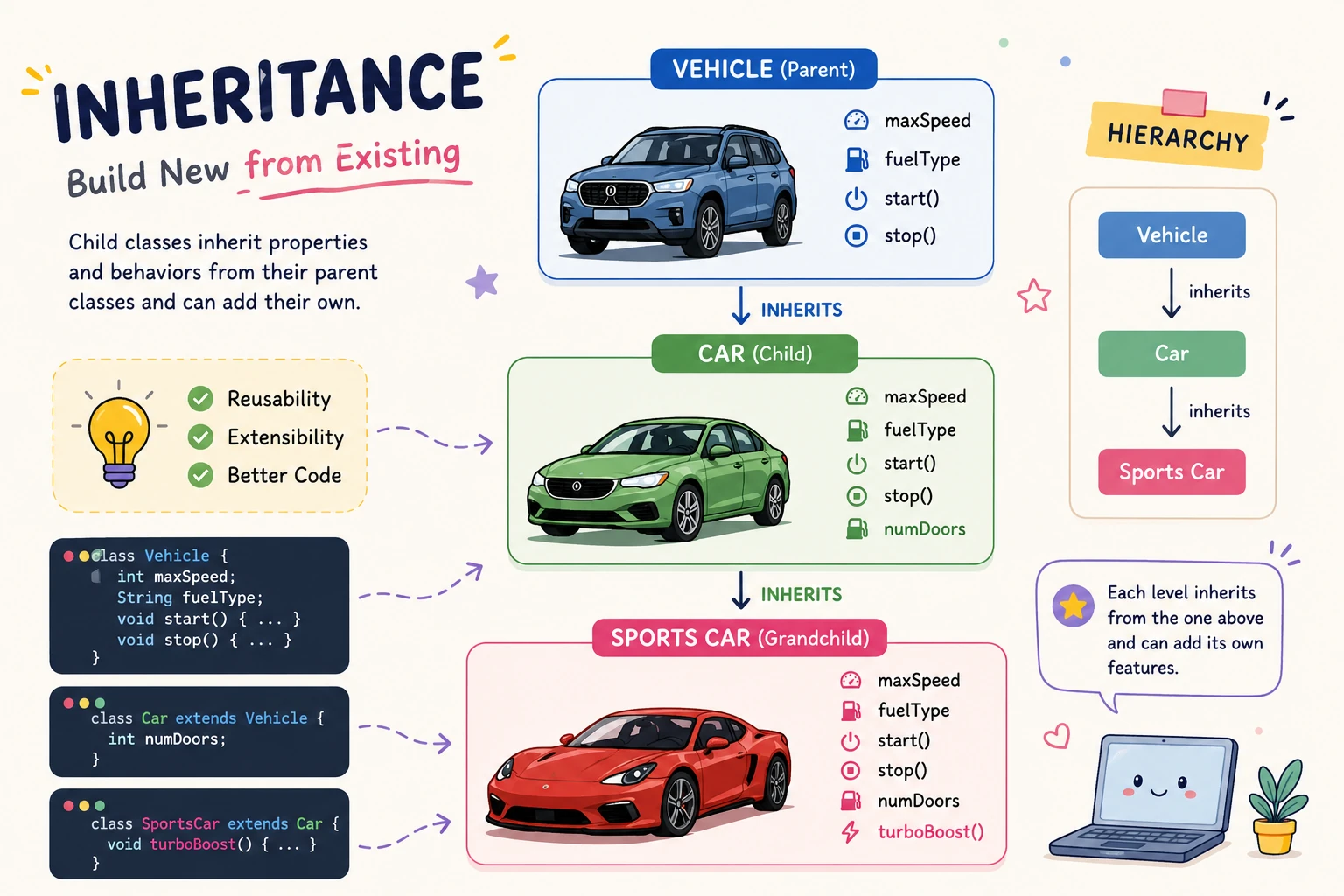
| Type of Inheritance | Description |
|---|---|
| Single | One child class inherits from one parent class |
| Multilevel | A class inherits from a class that itself inherits from another |
| Hierarchical | Multiple child classes inherit from the same parent class |
| Multiple (via interfaces) | A class implements more than one interface — Java doesn't allow multiple class inheritance directly |
Q: Why doesn't Java support multiple inheritance through classes? A: Java avoids multiple inheritance through classes to prevent the "Diamond Problem," where a class inheriting from two parent classes with a method of the same signature would create ambiguity about which version to use; Java resolves this by allowing multiple inheritance only through interfaces.
Polymorphism
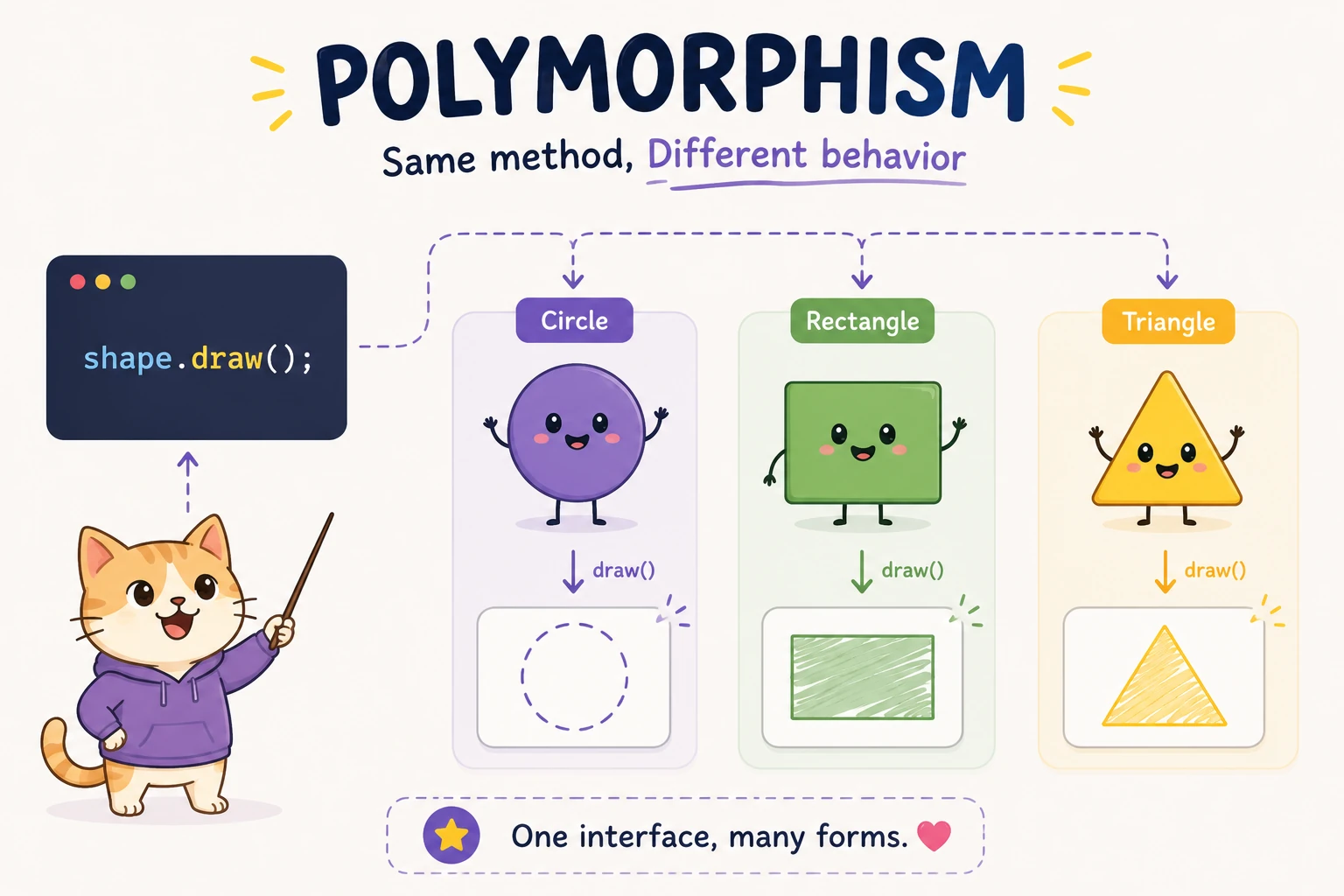
Polymorphism allows the same method name to behave differently depending on the object or parameters involved, existing in two forms: Compile-Time (Method Overloading) and Runtime (Method Overriding).
Quick Revision
- Encapsulation → data + methods bound together, access restricted (how it's protected).
- Abstraction → hides complexity, shows only essentials (what is shown).
- Inheritance → child class reuses parent class code; Java allows multiple inheritance only via interfaces.
- Polymorphism → one method name, many behaviors (overloading = compile-time, overriding = runtime).
4. Method Overloading vs Method Overriding
Method Overloading occurs within the same class when multiple methods share a name but differ in parameters, resolved at compile time, while Method Overriding occurs between a parent and child class when the child redefines a method with the same signature, resolved at runtime.
| Feature | Method Overloading | Method Overriding |
|---|---|---|
| Binding Time | Compile time (Static Binding) | Runtime (Dynamic Binding) |
| Class Involved | Same class | Parent and child class (inheritance) |
| Parameters | Must differ in number/type | Must be exactly the same as the parent method's |
| Purpose | Compile-time (static) polymorphism | Runtime (dynamic) polymorphism |
Q: What is the difference between Method Overloading and Method Overriding? A: Method Overloading occurs within the same class when multiple methods share a name but differ in parameters, and is resolved at compile time. Method Overriding occurs between a parent and child class when the child redefines a method with the same signature, and is resolved at runtime.
Quick Revision
- Overloading → same class, different parameters, compile-time.
- Overriding → parent-child, same signature, runtime.
- Overloading = static polymorphism; Overriding = dynamic polymorphism.
5. Abstract Class vs Interface
An Abstract Class can have constructors and maintain state through instance variables while supporting only single inheritance, whereas an Interface traditionally defines only a contract of methods and allows a class to implement multiple interfaces.
| Feature | Abstract Class | Interface |
|---|---|---|
| Constructors | Can have constructors | Cannot have constructors |
| State (Instance Variables) | Can contain state | Traditionally used only for method contracts |
| Method Implementation | Can have both abstract and concrete methods | Traditionally all methods are abstract (until Java 8 default methods) |
| Inheritance | A class can extend only one abstract class | A class can implement multiple interfaces |
Q: What is the difference between an Abstract Class and an Interface? A: An Abstract Class can have constructors, maintain state, and supports only single inheritance, while an Interface traditionally cannot have constructors, defines only a contract of methods, and allows a class to implement multiple interfaces at once.
Q: When should you use an Interface instead of an Abstract Class? A: Use an Interface when you need to define a contract that unrelated classes can implement in their own way, especially when a class needs to inherit behavior from more than one source, since Java permits implementing multiple interfaces but extending only one class.
Quick Revision
- Abstract Class → constructors + state allowed, single inheritance only.
- Interface → pure contract (traditionally), multiple implementation allowed.
- Need multiple inheritance of behavior? Use interfaces.
6. Association, Aggregation & Composition
Association is a general relationship between two independent objects, Aggregation is a "has-a" relationship where the child can exist independently of the parent, and Composition is a stronger "has-a" relationship where the child cannot exist without the parent.
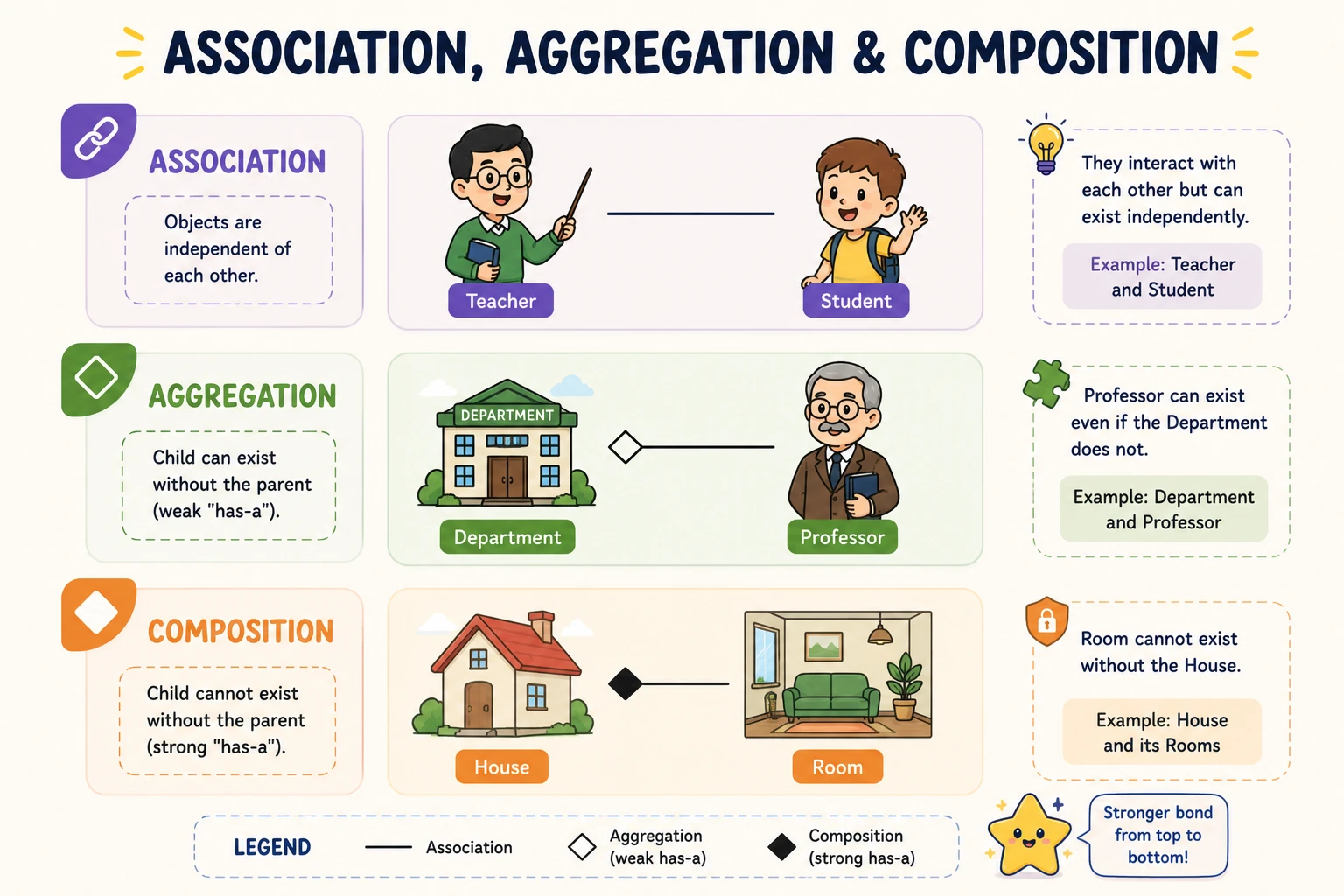
| Relationship | Dependency | Example |
|---|---|---|
| Association | Objects are independent of each other | A Teacher and a Student |
| Aggregation | Child can exist without the parent (weak "has-a") | A Department and a Professor |
| Composition | Child cannot exist without the parent (strong "has-a") | A House and its Rooms |
Q: What is the difference between Aggregation and Composition? A: In Aggregation, the child object can exist independently even if the parent object is destroyed, representing a weaker "has-a" relationship, such as a Department existing without a specific Professor. In Composition, the child object's lifecycle is tied to the parent, and it cannot exist without it, such as a Room ceasing to exist if the House is destroyed.
Quick Revision
- Association → independent objects, general relationship.
- Aggregation → weak "has-a," child survives without parent.
- Composition → strong "has-a," child dies with parent.
7. Constructors, 'this', and 'super'
A Constructor is a special method automatically invoked when an object is created, used to initialize the object's state, and it shares the same name as its class with no return type.
| Keyword | Refers To | Common Use |
|---|---|---|
this | The current object of the class | Distinguishing instance variables from parameters, calling another constructor in the same class |
super | The immediate parent class | Accessing parent class methods/variables, calling the parent's constructor |
Q: What is the difference between this and super keyword in Java?
A: The this keyword refers to the current object of a class and is used to access its own members or call another constructor within the same class, while the super keyword refers to the immediate parent class and is used to access its members or invoke its constructor.
Quick Revision
- Constructor → same name as class, no return type, runs on object creation.
this→ refers to the current object.super→ refers to the immediate parent class.
8. Static Binding vs Dynamic Binding
Static Binding is resolved at compile time and is used for overloaded methods, while Dynamic Binding is resolved at runtime and is used for overridden methods, enabling runtime polymorphism.
| Feature | Static Binding | Dynamic Binding |
|---|---|---|
| Resolved At | Compile time | Runtime |
| Associated With | Method Overloading | Method Overriding |
| Also Known As | Early Binding | Late Binding |
Q: Which binding is used for method overriding, and why? A: Dynamic Binding (Late Binding) is used for method overriding because the JVM determines which overridden method to execute based on the actual object type at runtime, not the reference type known at compile time.
Quick Revision
- Static/Early Binding → compile time, used for overloading.
- Dynamic/Late Binding → runtime, used for overriding.
Why OOP Is Used
| Advantage | Benefit |
|---|---|
| Modularity | Code is organized into self-contained objects/classes |
| Reusability | Inheritance allows existing code to be reused and extended |
| Security | Encapsulation restricts unauthorized access to data |
| Maintainability | Changes to one class have minimal impact on others |
| Real-world Modeling | Objects naturally map to real-world entities, easing design |
Quick Revision Cheat Sheet
One final scan before your mock test.
| Concept | Remember |
|---|---|
| Four Pillars of OOP | Encapsulation, Abstraction, Inheritance, Polymorphism |
| Class | Blueprint (logical, no memory) |
| Object | Instance (physical, occupies memory) |
| Encapsulation focuses on | How data is protected |
| Abstraction focuses on | What is shown to the user |
| Overloading | Same class, different parameters, compile-time |
| Overriding | Parent-child, same signature, runtime |
| Abstract Class | Constructors + state allowed, single inheritance |
| Interface | Pure contract, multiple implementation allowed |
| Aggregation | Weak "has-a" — child survives without parent |
| Composition | Strong "has-a" — child dies with parent |
this keyword | Refers to the current object |
super keyword | Refers to the immediate parent class |
| Static Binding | Compile time, used for overloading |
| Dynamic Binding | Runtime, used for overriding |
What to Study Next
As dedicated articles are published, this section will link out to deeper dives on each pillar.
- Encapsulation in Java
- Abstraction in Java
- Inheritance in Java
- Polymorphism in Java
Meanwhile, you can check out IBPS SO IT Officer OOPs Important Questions: Encapsulation, Inheritance, Polymorphism, Abstraction, and more.
Practice Topic-wise Mock Tests
Revise one topic at a time, then reinforce it immediately with a matching test.
Ready to Test Your IT Professional Knowledge?
Access subject-wise free mock tests for every IT domain topic — OOPs Concepts, Computer Networks, OS, DBMS, Software Engineering, and DSA — with detailed explanations and AI-powered question generation.
Final Thoughts
OOPs Concepts reward sharp comparisons over memorized definitions: know the four pillars cold, be able to separate Overloading from Overriding and Abstract Class from Interface without hesitation, and keep Aggregation vs Composition straight using the "does the child survive without the parent?" test. Work through this guide top to bottom once, then validate your recall with MockSensei's topic-wise tests before attempting a full-length Professional Knowledge mock.
Enjoyed this revision guide?
We share daily formula cheat sheets, practice questions, and upcoming exam notifications in our broadcast channels.