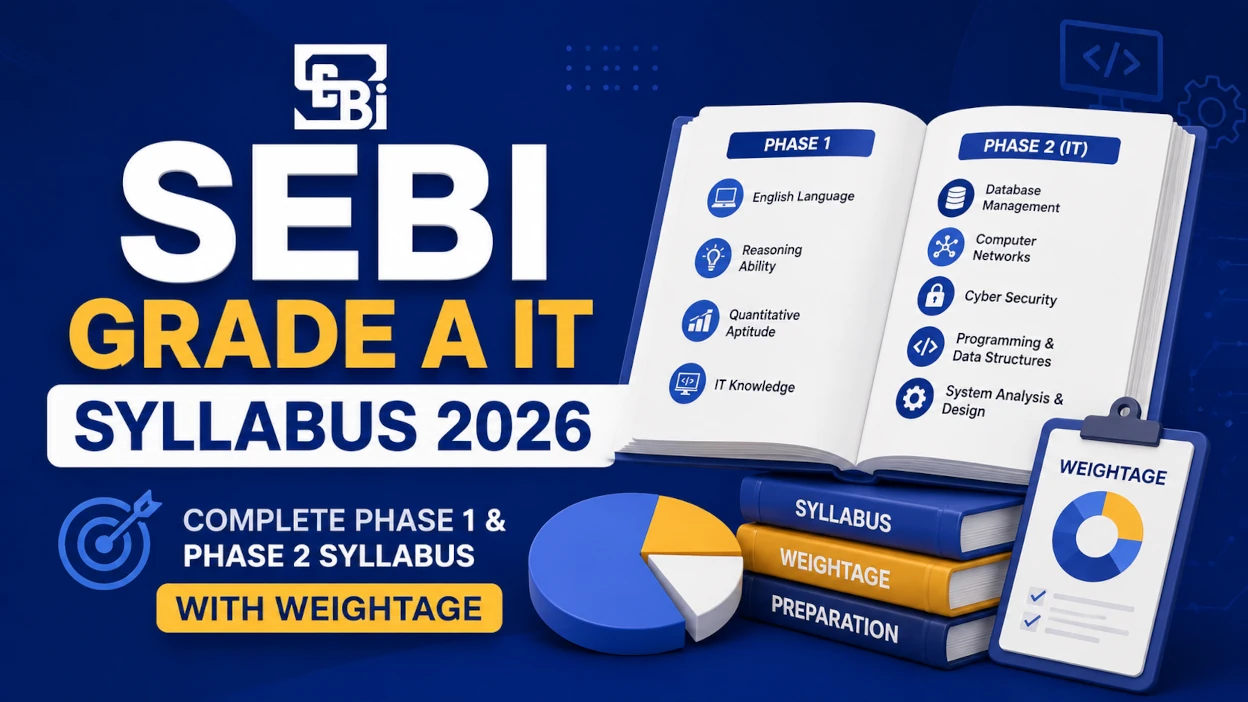
If you are preparing for the SEBI Grade A IT Officer exam, understanding the syllabus should be your first step.
The Information Technology syllabus is not limited to programming. It covers Programming, DBMS, SQL, Algorithms, Computer Networks, Cyber Security, Data Analytics, Data Warehousing and Shell Programming in Phase 1. Phase 2 is more focused on technical problem-solving, with Data Structures, Algorithms, Object-Oriented Programming and String Manipulation forming the core of the IT paper.
Please Note: As of 31 August 2026, SEBI has not released a separate Grade A 2026 notification. This syllabus guide is based on the latest official SEBI Grade A recruitment syllabus available from the 2025 recruitment cycle, and will be updated if SEBI makes any changes in the 2026 notification.
Important: The weightages mentioned below are indicative weightages from the latest official syllabus. They should not be treated as a guarantee of the exact number of questions in the examination.
For the complete recruitment details, eligibility, exam pattern, salary and selection process, see our SEBI Grade A IT Officer guide.
SEBI Grade A IT Syllabus at a Glance
The IT syllabus is divided into two major parts.
Phase 1 IT Syllabus
| Topic | Indicative Weightage |
|---|---|
| Programming Concepts | 30% |
| Database Concepts | 10% |
| SQL Queries | 10% |
| Data Analytics Languages | 10% |
| Algorithms for Problem Solving | 10% |
| Networking Concepts | 10% |
| Information & Cyber Security | 10% |
| Data Warehousing | 5% |
| Shell Programming | 5% |
| Total | 100% |
Phase 2 IT Syllabus
| Topic | Indicative Weightage |
|---|---|
| Data Structures | 40% |
| Algorithms | 30% |
| Object-Oriented Programming | 20% |
| String Manipulation | 10% |
| Total | 100% |
The official syllabus gives the highest Phase 1 weightage to Programming Concepts and the highest Phase 2 weightage to Data Structures — so don't divide your preparation time equally across all subjects.
SEBI Grade A IT Phase 1 Syllabus
Phase 1 Paper 2 is the specialized IT paper, covering nine major areas.
1. Programming Concepts — 30%
The highest-weightage topic in Phase 1. Covers iteration, recursion, functions, variable scope, binding, parameter passing, functional and logic programming, and OOP (classes, objects, inheritance, constructors, exception handling), referenced against Java, C and C++.
Important topics: variables and data types, operators, conditional statements, loops, functions, recursion, scope of variables, parameter passing, classes and objects, constructors, inheritance, polymorphism, exception handling, basic memory concepts, program output questions.
Preparation priority: Very High — complete this first since it carries 30% of Phase 1 and directly supports Phase 2.
2. Database Concepts — 10%
Covers ER model, relational model, relational algebra, tuple calculus, integrity constraints, normalization, normal forms, file organization, indexing, B-trees/B+ trees, transactions and concurrency control.
Important topics: ER diagrams, entities and relationships, keys, functional dependencies, normalization (1NF–BCNF), relational algebra operators, transactions, ACID properties, serializability, concurrency control, indexing, B-tree vs B+ tree.
Preparation priority: High — DBMS connects directly with SQL, so study them together. Explore our DBMS revision notes.
3. SQL Queries — 10%
Covers SELECT, VIEW, TRUNCATE, DELETE, UPDATE, ALTER, joins, aggregate functions, UNION, INTERSECT, EXCEPT, IN, EXISTS, and nested queries.
Important topics: basic SELECT queries, WHERE, GROUP BY, HAVING, ORDER BY, aggregate functions, join types, subqueries, correlated subqueries, IN/EXISTS, UNION/INTERSECT/EXCEPT, views, DDL vs DML, DELETE vs TRUNCATE.
Preparation priority: High
Don't learn SQL by memorizing syntax alone — practice writing queries and predicting their output.
4. Data Analytics Languages — 10%
Covers Python, R, data structures, regular expressions, file handling, data import/export, and basic data manipulation and analysis concepts.
Important topics (Python): lists, tuples, sets, dictionaries, strings, functions, file handling, basic regular expressions. Important topics (R): basic syntax, data structures, functions, data manipulation concepts.
Preparation priority: Medium — stick to syllabus-relevant, objective-type coverage rather than a full data-science course.
5. Algorithms for Problem Solving — 10%
Covers searching, sorting, recursion, algorithmic complexity and problem-solving techniques.
Important topics: linear search, binary search, bubble/selection/insertion/merge/quick sort, time and space complexity, recursion.
Preparation priority: Very High — even though the Phase 1 weightage is only 10%, this topic reappears in Phase 2 with much higher weightage.
6. Networking Concepts — 10%
Covers network models, protocols, IP addressing, routing, switching, network devices, communication concepts and basic network security.
Important topics: OSI model, TCP/IP model, TCP vs UDP, HTTP/HTTPS, DNS, DHCP, FTP, SMTP, IPv4/IPv6, subnetting, routers, switches, hubs, network layers, common protocols.
Preparation priority: High — a concept-heavy subject; concise revision notes plus regular MCQ practice work best.
7. Information & Cyber Security — 10%
Covers information security, authentication, authorization, encryption, malware, cyber attacks, firewalls, network security and security controls.
Important topics: CIA triad, authentication vs authorization, access control, symmetric/asymmetric encryption, hashing, digital signatures, malware types (viruses, worms, trojans), phishing, spoofing, denial-of-service attacks, firewalls.
Preparation priority: High — a good subject for short revision notes followed by heavy question practice.
8. Data Warehousing — 5%
Covers data warehouse concepts, ETL, OLAP, OLTP, star schema, snowflake schema and data mining basics.
Important topics: data warehouse vs database, OLTP vs OLAP, ETL, data marts, fact and dimension tables, star vs snowflake schema, basic data mining concepts.
Preparation priority: Medium — focus on high-frequency concepts rather than over-investing time here.
9. Shell Programming — 5%
Covers shell commands, variables, conditions, loops, shell scripting and command-line operations.
Important topics: basic Linux commands, file/directory operations, permissions, variables, conditional statements, loops, shell scripts, input/output, pipes, redirection.
Preparation priority: Medium — cover fundamentals properly, but don't match the time you give to Programming or DBMS.
SEBI Grade A IT Phase 2 Syllabus
Phase 2 is considerably more focused than Phase 1, with the IT paper built around four major areas.
Key insight: Data Structures and Algorithms together account for 70% of the indicative Phase 2 IT syllabus. Candidates weak in DSA should start well before Phase 1 is over.
1. Data Structures — 40%
The highest-weightage topic in Phase 2. Covers arrays, linked lists, stacks, queues, binary trees, indexing, binary search trees, heaps, hashing, matrices and JSON objects.
Arrays — one-dimensional and multidimensional arrays, searching, insertion, deletion, traversal. Linked Lists — singly, doubly and circular linked lists; insertion, deletion, traversal. Stack — push, pop, peek, applications, expression evaluation. Queue — enqueue, dequeue, circular queue, priority queue, applications. Trees — binary trees, tree traversal (preorder, inorder, postorder, level-order). Binary Search Tree — searching, insertion, deletion, traversal. Heap — min heap, max heap, heap operations, heap sort. Hashing — hash functions, collision handling, chaining, open addressing.
Preparation priority: Extremely High — this should be one of the most heavily practiced areas in your entire preparation.
2. Algorithms — 30%
Covers sorting, searching, greedy algorithms, dynamic programming, backtracking, divide and conquer, and pattern searching.
Important topics: linear/binary search, bubble/selection/insertion/merge/quick/heap sort, greedy algorithms, dynamic programming, backtracking, divide and conquer, pattern matching, plus complexity analysis — best/average/worst case, time and space complexity, Big-O notation.
Preparation priority: Extremely High — don't memorize algorithm names. Understand what problem each one solves, how it works, its complexity, when to use it, and its limitations.
3. Object-Oriented Programming — 20%
Covers abstraction, encapsulation, polymorphism and inheritance.
Important topics: classes, objects, constructors, inheritance, method overriding vs overloading, encapsulation, abstraction, interfaces, polymorphism — practiced in Java, C++, or another familiar OOP language.
Preparation priority: High — don't restrict yourself to definitions; practice code-based questions on inheritance, constructors, overriding and polymorphism.
4. String Manipulation — 10%
Covers string length, substrings, regular expressions and searching.
Important topics: string traversal, character counting, substrings, string comparison, pattern searching, regular expressions, basic string algorithms.
Preparation priority: Medium — a smaller section, but useful programming practice regardless.
Phase 1 vs Phase 2 IT Syllabus
| Area | Phase 1 | Phase 2 |
|---|---|---|
| Programming | 30% | — |
| DBMS | 10% | — |
| SQL | 10% | — |
| Data Analytics | 10% | — |
| Algorithms | 10% | 30% |
| Networking | 10% | — |
| Cyber Security | 10% | — |
| Data Warehousing | 5% | — |
| Shell Programming | 5% | — |
| Data Structures | — | 40% |
| OOP | Included within Programming | 20% |
| String Manipulation | — | 10% |
Phase 1 tests a broad range of IT concepts. Phase 2 is much more concentrated around DSA, Algorithms, OOP and String Manipulation — which is why Phase 2 prep shouldn't be postponed until Phase 1 is done.
Most Important Topics for SEBI Grade A IT
If your preparation time is limited, use the indicative weightages to prioritize.
Priority 1 — Must master: Programming, Data Structures, Algorithms, DBMS, SQL, OOP — high weightage or heavy overlap across the exam.
Priority 2 — Strong preparation: Computer Networks, Cyber Security, Data Analytics.
Priority 3 — Complete but don't overinvest: Data Warehousing, Shell Programming.
Lower weightage does not mean zero questions — the official percentages are indicative, not a hard cap.
Smart Preparation Strategy
Don't prepare the syllabus top to bottom — use overlapping subjects to save time:
Programming Fundamentals → Data Structures → Algorithms → OOP → DBMS → SQL → Networking → Cyber Security → Data Analytics → Data Warehousing → Shell Programming
Why start with Programming? It's the largest component of Phase 1 and the foundation for DSA, Algorithms and OOP.
Why start DSA early? DSA and Algorithms together make up 70% of the indicative Phase 2 IT syllabus, and take considerably more time to learn than theory-based subjects.
Why study DBMS and SQL together?
Relational Model → Keys & Constraints → Normalization → Transactions → SQL → Joins & Subqueries
This builds a much stronger understanding than studying SQL commands in isolation.
Preparation Priority Matrix
| Subject | Weightage/Importance | Priority |
|---|---|---|
| Programming | 30% Phase 1 | Very High |
| Data Structures | 40% Phase 2 | Very High |
| Algorithms | 10% Phase 1 + 30% Phase 2 | Very High |
| DBMS | 10% Phase 1 | High |
| SQL | 10% Phase 1 | High |
| OOP | 20% Phase 2 | High |
| Networking | 10% Phase 1 | High |
| Cyber Security | 10% Phase 1 | High |
| Data Analytics | 10% Phase 1 | Medium |
| Data Warehousing | 5% Phase 1 | Medium |
| Shell Programming | 5% Phase 1 | Medium |
This table is a preparation recommendation based on the syllabus, not an official SEBI ranking.
How Much Time Should You Spend on Each Topic?
If you're starting from scratch, a reasonable technical study-time allocation looks like this:
| Area | Approx. Study Time |
|---|---|
| Programming + OOP | 20% |
| Data Structures | 20% |
| Algorithms | 15% |
| DBMS + SQL | 15% |
| Networking | 10% |
| Cyber Security | 8% |
| Data Analytics | 5% |
| Data Warehousing | 4% |
| Shell Programming | 3% |
This is not an official weightage — it's a practical allocation that accounts for both exam weightage and the extra time DSA/Algorithms need to build real problem-solving ability.
SEBI Grade A IT Syllabus for Beginners
If your IT fundamentals are weak, don't start with the entire syllabus at once — follow this order instead.
Stage 1 — Programming: variables, conditions, loops, functions, arrays, strings, recursion, OOP. Stage 2 — Data Structures: arrays, linked lists, stack, queue, trees, BST, heap, hashing. Stage 3 — Algorithms: searching, sorting, recursion, divide and conquer, greedy, dynamic programming, backtracking. Stage 4 — Core IT: DBMS, SQL, networking, cyber security, data analytics, data warehousing, shell programming.
This staged approach is far more manageable than studying nine subjects simultaneously.
Revision Strategy
Revise the syllabus multiple times, using a cycle like:
First Study → Topic-wise Questions → First Revision → Mixed Questions → Second Revision → Mock Tests → Mistake Revision
For technical subjects, question practice is part of learning — not something you save for after finishing the syllabus.
SEBI Grade A IT Practice Questions
Once you finish a topic, solve questions immediately:
- After DBMS: keys, normalization, transactions, concurrency, indexing, relational algebra
- After SQL: joins, nested queries, aggregate functions, GROUP BY, HAVING, EXISTS, UNION
- After DSA: arrays, linked lists, trees, stacks, queues, hashing, heaps
- After Algorithms: searching, sorting, complexity, greedy, DP, backtracking
Once multiple subjects are complete, move to mixed-topic tests.
SEBI Grade A IT Previous Year Questions
PYQs help you understand frequently tested concepts, real question difficulty, repeated concepts, your weak areas, time-consuming topics and common traps. But don't prepare only from PYQs — the syllabus is broader than the questions you've already seen.
Your preparation should follow: Syllabus → Concepts → Practice → PYQs → Mock Tests.
SEBI Grade A IT Syllabus PDF
Candidates often search for a "SEBI Grade A IT syllabus PDF." Instead of relying on random PDFs from coaching websites, use the official SEBI recruitment notification as the authoritative source, and re-check the latest syllabus against the notification issued for the relevant year.
Important: Once SEBI publishes the Grade A 2026 notification, compare the new syllabus with the 2025 syllabus in this article before continuing your preparation plan.
Final Takeaway
The SEBI Grade A IT syllabus looks large at first, but becomes manageable once you divide it by weightage and preparation priority.
For Phase 1, focus heavily on Programming + DBMS + SQL + Algorithms, then cover Networking + Cyber Security + Data Analytics, and finally complete Data Warehousing + Shell Programming.
For Phase 2, your biggest priorities are Data Structures → Algorithms → OOP → String Manipulation.
The most important point: DSA and Algorithms should not be left for the last few weeks. They account for 70% of the indicative Phase 2 IT syllabus and need practice, not just reading.
Put This Syllabus Into Practice
Take a Free SEBI Grade A IT Mock Test
Read the complete recruitment details, eligibility, exam pattern, salary and selection process in our SEBI Grade A IT Officer guide.