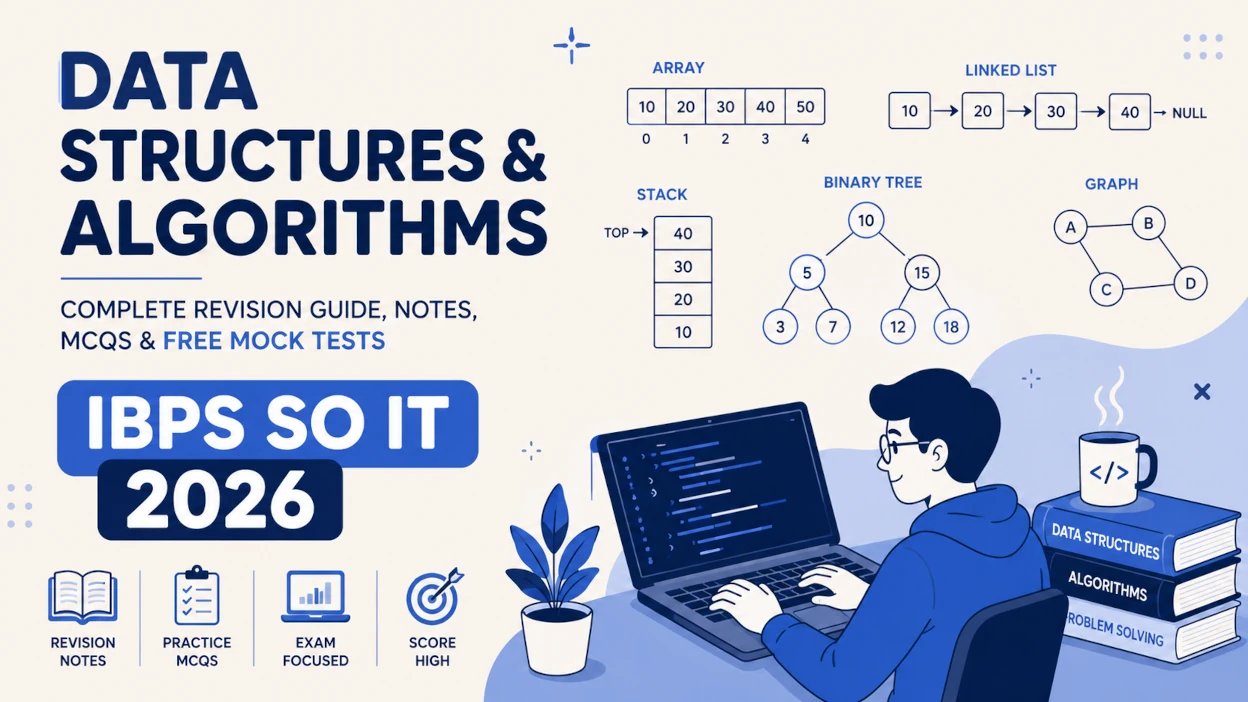
Data Structures & Algorithms for IBPS SO IT Officer 2026
A Data Structure is a specific way of organizing and storing data to enable efficient access and modification, while an Algorithm is a step-by-step procedure for solving a problem or performing a computation. IBPS SO IT Officer tests this subject mainly through conceptual comparisons — Array vs Linked List, Stack vs Queue, Linear vs Binary Search — and through time-complexity facts, rather than through writing code.
This guide is a single-page revision hub: concise notes, comparison tables, and a priority order for what to study first, followed by topic-wise and full-length mock tests.
Topic Priority for Revision
Previous year papers show a consistent pattern in which DSA topics get tested most. Use this single table to sequence your revision.
| Topic | Exam Weightage | Revise |
|---|---|---|
| Time & Space Complexity (Big-O) | ⭐⭐⭐⭐⭐ | First |
| Arrays vs Linked List | ⭐⭐⭐⭐⭐ | First |
| Stack & Queue | ⭐⭐⭐⭐⭐ | First |
| Sorting Algorithms | ⭐⭐⭐⭐⭐ | First |
| Searching Algorithms | ⭐⭐⭐⭐☆ | Second |
| Tree Traversals (Binary Tree/BST) | ⭐⭐⭐⭐☆ | Second |
| Graphs (BFS/DFS) | ⭐⭐⭐☆☆ | Second |
| Recursion | ⭐⭐⭐☆☆ | Third |
| Hashing | ⭐⭐⭐☆☆ | Third |
| Heaps | ⭐⭐☆☆☆ | Third |
Exam-day shortage of time? Cover every "First" row above, then Searching and Tree Traversals — together these account for the majority of DSA questions in past IBPS SO IT Officer papers.
Start Your Data Structures & Algorithms Revision
Revise the topics above, then reinforce them with an AI-generated topic-wise mock test built for the IBPS SO IT Officer exam.
1. DSA Fundamentals & Time Complexity
A Data Structure organizes data for efficient storage and retrieval, and is broadly classified as Linear (elements arranged sequentially) or Non-Linear (elements arranged hierarchically or in a network).
Linear vs Non-Linear Data Structures
| Type | Arrangement | Examples |
|---|---|---|
| Linear | Elements arranged sequentially, one after another | Array, Linked List, Stack, Queue |
| Non-Linear | Elements arranged hierarchically or as a network | Tree, Graph |
Big-O Complexity Reference (Master Table)
Big-O notation describes how an algorithm's running time or space requirement grows as the input size increases, and is the single most frequently tested numerical concept in this subject.
| Notation | Name | Example |
|---|---|---|
| O(1) | Constant | Array index access |
| O(log n) | Logarithmic | Binary Search |
| O(n) | Linear | Linear Search, single loop traversal |
| O(n log n) | Linearithmic | Merge Sort, Quick Sort (average case) |
| O(n²) | Quadratic | Bubble Sort, Selection Sort, Insertion Sort |
| O(2ⁿ) | Exponential | Naive recursive Fibonacci |
Q: What does O(1) time complexity mean? A: O(1), or constant time, means an operation takes the same amount of time regardless of the input size — such as accessing an array element directly by its index.
Q: Why is O(log n) considered efficient for large inputs? A: O(log n) is efficient because the number of operations grows very slowly as input size increases — doubling the input adds only one more step, which is why Binary Search remains fast even on very large sorted datasets.
Quick Revision
- Linear structures = sequential (Array, Linked List, Stack, Queue).
- Non-Linear structures = hierarchical/network (Tree, Graph).
- Complexity order (fastest to slowest): O(1) < O(log n) < O(n) < O(n log n) < O(n²) < O(2ⁿ).
2. Arrays vs Linked List
An Array stores elements in contiguous memory locations with a fixed size, allowing fast index-based access, while a Linked List stores elements in scattered memory locations connected by pointers, allowing dynamic resizing but only sequential access.
| Feature | Array | Linked List |
|---|---|---|
| Memory Allocation | Contiguous | Non-contiguous (scattered, linked via pointers) |
| Size | Fixed at creation (static) | Dynamic — can grow or shrink at runtime |
| Access Time | O(1) — direct index access | O(n) — sequential traversal required |
| Insertion/Deletion | O(n) — may require shifting elements | O(1) at a known position — no shifting needed |
| Memory Overhead | Low — no extra pointer storage | Higher — each node stores a pointer/reference |
Types of Linked Lists
| Type | Structure |
|---|---|
| Singly Linked List | Each node points only to the next node |
| Doubly Linked List | Each node points to both the next and previous node |
| Circular Linked List | The last node points back to the first node, forming a loop |
Q: What is the difference between an Array and a Linked List? A: An Array stores elements in contiguous memory with a fixed size and allows O(1) random access via an index, while a Linked List stores elements in scattered memory connected by pointers, supports dynamic resizing, but only allows O(n) sequential access.
Q: Why is insertion faster in a Linked List than in an Array? A: Insertion in a Linked List only requires updating a few pointers at the insertion point, whereas insertion in an Array may require shifting all subsequent elements to make room, making the Linked List insertion O(1) at a known position versus O(n) for the Array.
Quick Revision
- Array → fast access (O(1)), slow insert/delete (O(n)), fixed size.
- Linked List → slow access (O(n)), fast insert/delete (O(1)), dynamic size.
- Doubly Linked List → traversal in both directions; Circular → last node links back to first.
3. Stack & Queue
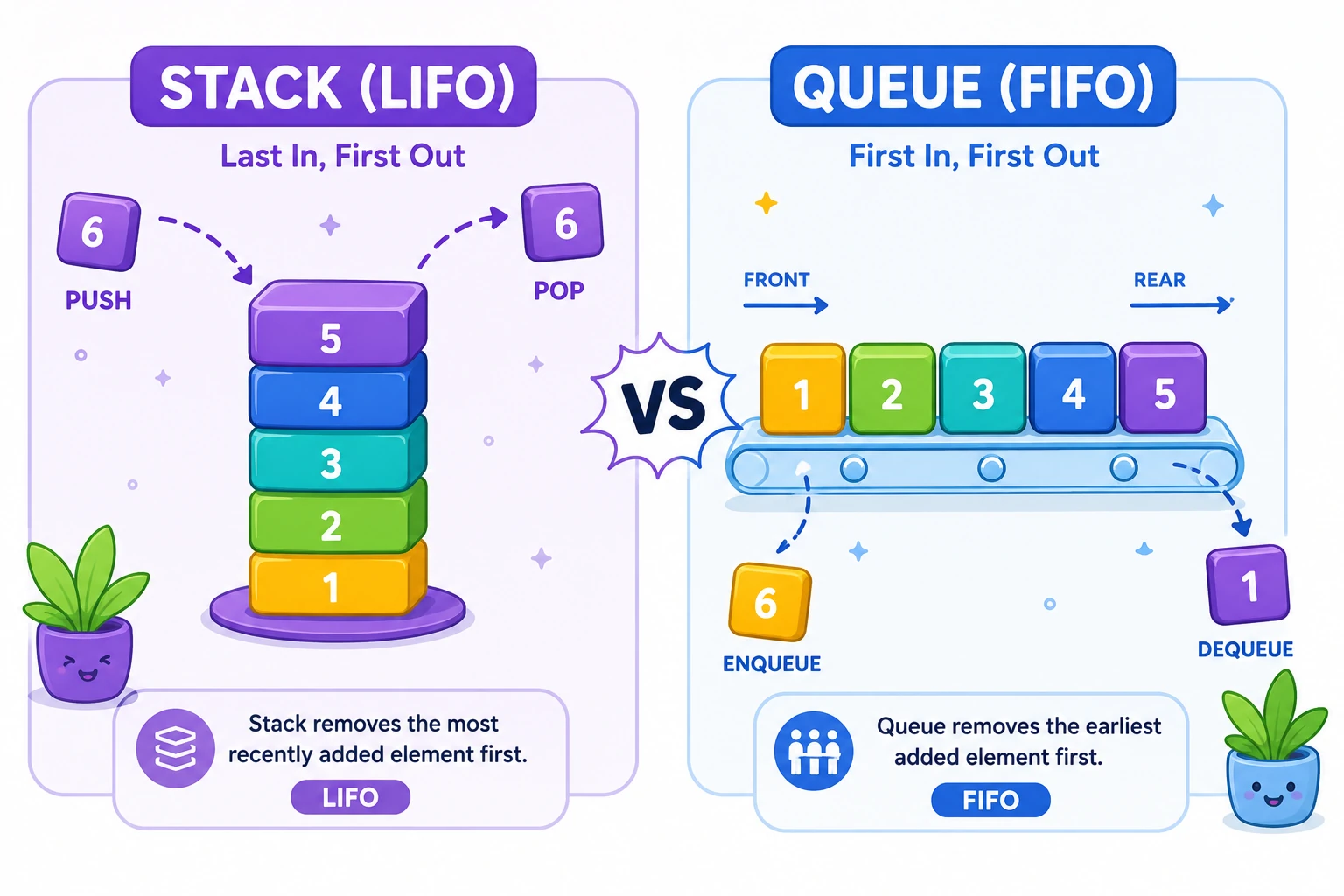
A Stack is a linear data structure that follows the Last In First Out (LIFO) principle, while a Queue follows the First In First Out (FIFO) principle.
Stack
| Operation | Function |
|---|---|
| Push | Adds an element to the top of the stack |
| Pop | Removes the element from the top of the stack |
| Peek/Top | Returns the top element without removing it |
Common applications: Undo functionality, expression evaluation, function call management (call stack), backtracking algorithms.
Queue
| Type | Description |
|---|---|
| Simple Queue | Insertion at rear, deletion from front |
| Circular Queue | Last position connects back to the first, reusing empty space |
| Priority Queue | Elements are served based on priority, not arrival order |
| Deque (Double-Ended Queue) | Insertion and deletion allowed at both ends |
Common applications: CPU task scheduling, print queue management, handling requests in order of arrival (Simple Queue), or by priority (Priority Queue).
Q: What is the difference between a Stack and a Queue? A: A Stack follows the Last In First Out (LIFO) principle, where the most recently added element is removed first, while a Queue follows the First In First Out (FIFO) principle, where the earliest added element is removed first.
Q: Which data structure is used to implement recursion and undo functionality? A: A Stack is used, because both recursion (via the call stack) and undo functionality need to reverse the most recent action first, which matches the Stack's LIFO behavior.
Q: What is a Circular Queue and why is it used? A: A Circular Queue connects the last position back to the first, allowing the queue to reuse freed-up space at the front instead of leaving it permanently unused, which solves the memory-wastage problem of a Simple Queue implemented with a fixed-size array.
Quick Revision
- Stack = LIFO → push/pop/peek, used for undo & recursion.
- Queue = FIFO → enqueue/dequeue, used for scheduling.
- Circular Queue solves wasted space; Priority Queue serves by priority, not order.
4. Sorting Algorithms
Sorting Algorithms arrange elements of a list into a defined order, and IBPS SO IT Officer questions focus almost entirely on comparing their time complexity, space complexity, and stability rather than their implementation.
Master Sorting Comparison Table
| Algorithm | Best Case | Average Case | Worst Case | Space | Stable? | In-Place? |
|---|---|---|---|---|---|---|
| Bubble Sort | O(n) | O(n²) | O(n²) | O(1) | Yes | Yes |
| Selection Sort | O(n²) | O(n²) | O(n²) | O(1) | No | Yes |
| Insertion Sort | O(n) | O(n²) | O(n²) | O(1) | Yes | Yes |
| Merge Sort | O(n log n) | O(n log n) | O(n log n) | O(n) | Yes | No |
| Quick Sort | O(n log n) | O(n log n) | O(n²) | O(log n) | No | Yes |
Q: Which sorting algorithm has the best average-case time complexity? A: Merge Sort and Quick Sort both have an average-case time complexity of O(n log n), making them significantly faster than O(n²) algorithms like Bubble Sort, Selection Sort, and Insertion Sort on large datasets.
Q: What does it mean for a sorting algorithm to be "stable"? A: A stable sorting algorithm preserves the relative order of elements that have equal keys — for example, if two equal elements appear in a certain order in the input, a stable sort guarantees they appear in that same relative order in the output. Bubble Sort, Insertion Sort, and Merge Sort are stable; Selection Sort and Quick Sort are not.
Q: Why does Quick Sort have a worst-case time complexity of O(n²) despite being fast in practice? A: Quick Sort's worst case occurs when the chosen pivot repeatedly produces highly unbalanced partitions, such as when the array is already sorted and the first or last element is always chosen as the pivot, degrading performance to O(n²); in practice, with a good pivot strategy, it performs at O(n log n) on average.
Quick Revision
- O(n²) sorts: Bubble, Selection, Insertion — simple but slow for large inputs.
- O(n log n) sorts: Merge Sort (stable, needs extra space), Quick Sort (in-place, not stable).
- Stable: Bubble, Insertion, Merge. Not stable: Selection, Quick.
5. Searching Algorithms
Linear Search checks each element sequentially with O(n) time complexity and works on unsorted data, while Binary Search repeatedly halves a sorted array to achieve O(log n) time complexity.
| Feature | Linear Search | Binary Search |
|---|---|---|
| Data Requirement | Works on unsorted or sorted data | Requires sorted data |
| Time Complexity | O(n) | O(log n) |
| Method | Checks each element one by one | Repeatedly divides the search space in half |
| Best Suited For | Small or unsorted datasets | Large, sorted datasets |
Q: What is the difference between Linear Search and Binary Search? A: Linear Search checks each element sequentially and works on unsorted data with O(n) time complexity, while Binary Search repeatedly divides a sorted array in half, achieving O(log n) time complexity but requiring the data to be sorted first.
Q: Why can't Binary Search be used on unsorted data? A: Binary Search relies on comparing the middle element to decide which half of the array to search next, which only works correctly if the data is already sorted — on unsorted data, this comparison gives no reliable information about where the target might be.
Quick Revision
- Linear Search → O(n), no sorting needed.
- Binary Search → O(log n), sorted data required.
- Binary Search is faster but has a prerequisite: the data must be sorted first.
6. Trees & Tree Traversals
A Tree is a non-linear, hierarchical data structure consisting of nodes connected by edges, with one root node and no cycles; a Binary Tree restricts each node to at most two children.
Binary Search Tree (BST)
A Binary Search Tree is a Binary Tree where, for every node, all values in its left subtree are smaller and all values in its right subtree are larger than the node itself — this property makes searching, insertion, and deletion efficient.
| Operation | Average Case | Worst Case (unbalanced) |
|---|---|---|
| Search | O(log n) | O(n) |
| Insertion | O(log n) | O(n) |
| Deletion | O(log n) | O(n) |
Tree Traversal Types
The three depth-first traversal types are Inorder, Preorder, and Postorder, distinguished by the order in which the root is visited relative to its left and right subtrees.
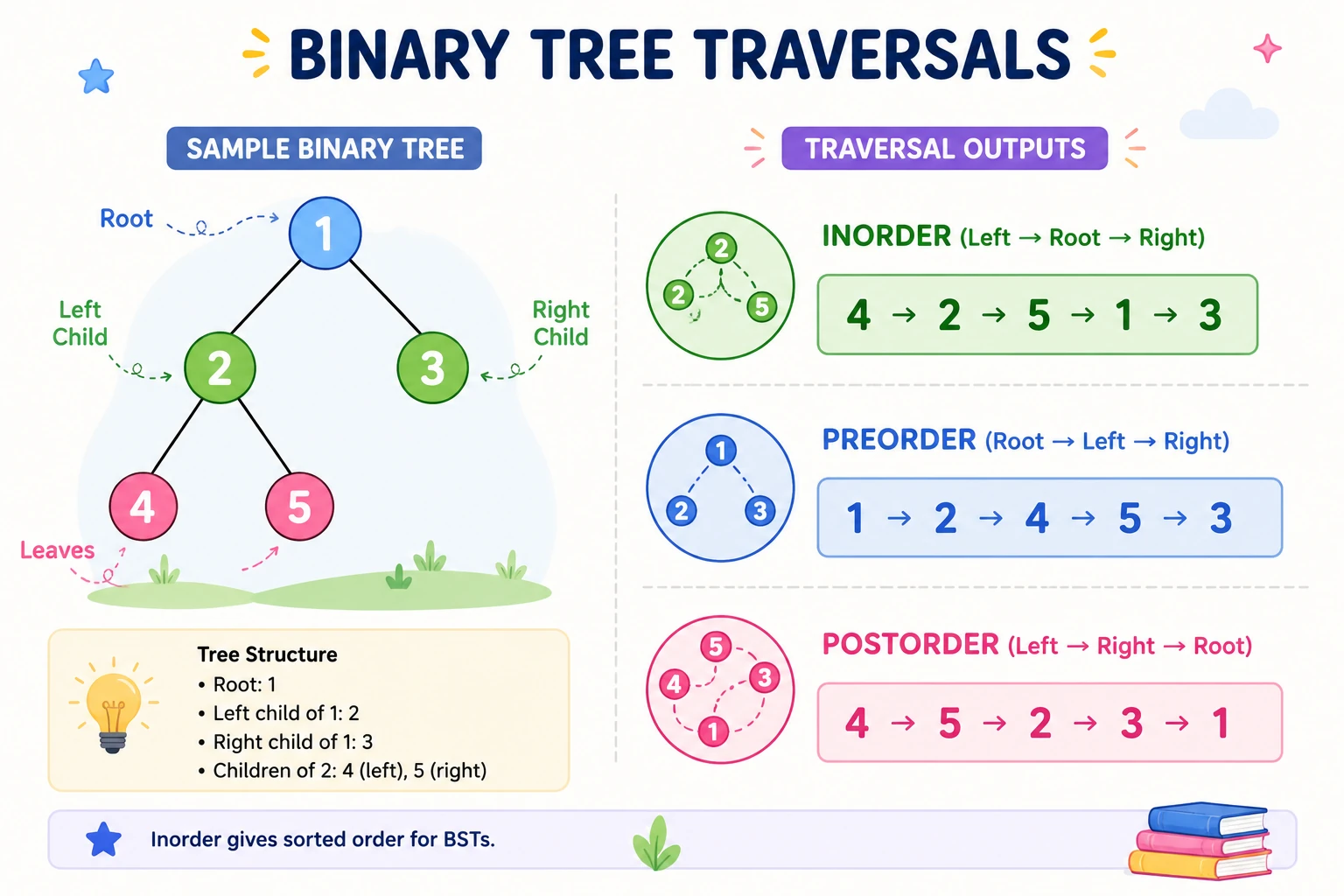
Consider this simple tree: root 1, with left child 2 and right child 3; node 2 has left child 4 and right child 5.
| Traversal | Order Rule | Output for the Sample Tree |
|---|---|---|
| Inorder | Left → Root → Right | 4, 2, 5, 1, 3 |
| Preorder | Root → Left → Right | 1, 2, 4, 5, 3 |
| Postorder | Left → Right → Root | 4, 5, 2, 3, 1 |
Q: What are the three types of tree traversal? A: The three depth-first tree traversal types are Inorder (Left, Root, Right), Preorder (Root, Left, Right), and Postorder (Left, Right, Root).
Q: What does Inorder traversal of a Binary Search Tree produce? A: Inorder traversal of a Binary Search Tree produces the elements in sorted ascending order, because the BST property ensures every left subtree contains smaller values and every right subtree contains larger values than the root.
Quick Revision
- Tree = hierarchical, one root, no cycles; BST = left < root < right at every node.
- Inorder = Left-Root-Right (gives sorted order for a BST).
- Preorder = Root-Left-Right; Postorder = Left-Right-Root.
- BST operations are O(log n) average, but degrade to O(n) if unbalanced.
7. Graphs: BFS vs DFS
A Graph is a non-linear data structure consisting of a set of vertices (nodes) connected by edges, used to represent networks such as social connections, maps, or web links.
Graph Traversal Algorithms
| Algorithm | Data Structure Used | Exploration Style |
|---|---|---|
| BFS (Breadth-First Search) | Queue | Explores all neighbors at the current level before going deeper |
| DFS (Depth-First Search) | Stack (or recursion) | Explores as far as possible along one branch, then backtracks |
Q: What is the difference between BFS and DFS? A: BFS (Breadth-First Search) explores a graph level by level using a queue, visiting all neighbors of a node before moving deeper, while DFS (Depth-First Search) explores as far as possible along one branch using a stack or recursion before backtracking to explore other branches.
Q: Which graph traversal algorithm finds the shortest path in an unweighted graph? A: BFS finds the shortest path in an unweighted graph, because it explores nodes level by level, guaranteeing that the first time it reaches a node is via the shortest possible path in terms of number of edges.
Quick Revision
- BFS → queue-based, level-by-level, finds shortest path (unweighted graphs).
- DFS → stack/recursion-based, goes deep before backtracking.
- Graphs can be represented via an Adjacency Matrix or an Adjacency List.
8. Recursion
Recursion is a technique where a function calls itself to solve a smaller instance of the same problem, continuing until a base case is reached.
| Aspect | Recursion | Iteration |
|---|---|---|
| Mechanism | Function calls itself | Uses loops (for, while) |
| Memory | Uses the call stack — higher memory usage | Uses a fixed amount of memory generally |
| Termination | Requires a base case to stop | Requires a loop condition to stop |
| Readability | Often more concise for problems with natural recursive structure | Can be more efficient for simple repetitive tasks |
Q: What is a base case in recursion, and why is it necessary? A: A base case is the condition under which a recursive function stops calling itself and returns a value directly; without a base case, the function would call itself infinitely, eventually causing a stack overflow.
Quick Revision
- Recursion = function calling itself + a base case to stop.
- Uses the call stack, which is why deep recursion risks stack overflow.
- Any recursive solution can be rewritten iteratively using an explicit stack.
9. Hashing
Hashing is a technique that maps data of arbitrary size to fixed-size values, called hash codes, using a hash function, enabling average-case O(1) lookup in a Hash Table.
| Term | Definition |
|---|---|
| Hash Function | Converts a key into an index/address in the hash table |
| Collision | Occurs when two different keys map to the same index |
| Chaining | Collision resolution using a linked list at each index |
| Open Addressing | Collision resolution by probing for the next available slot |
Q: What is a collision in hashing, and how is it resolved? A: A collision occurs when two different keys are mapped by the hash function to the same index in the hash table. It is commonly resolved using Chaining, where each index stores a linked list of all colliding elements, or Open Addressing, where the algorithm probes for the next available empty slot.
Quick Revision
- Hash Table → average O(1) search, insert, delete.
- Collision → two keys, same index; resolved via Chaining or Open Addressing.
Previous Year Focus
Based on previous IBPS SO IT Officer and related competitive examinations, the following topics have consistently received higher weightage.
| Topic | Exam Frequency |
|---|---|
| Time Complexity (Big-O) | ⭐⭐⭐⭐⭐ |
| Array vs Linked List | ⭐⭐⭐⭐⭐ |
| Stack vs Queue | ⭐⭐⭐⭐⭐ |
| Sorting Algorithm Comparison | ⭐⭐⭐⭐⭐ |
| Searching Algorithms | ⭐⭐⭐⭐☆ |
| Tree Traversals | ⭐⭐⭐⭐☆ |
| BFS vs DFS | ⭐⭐⭐☆☆ |
| Recursion Basics | ⭐⭐⭐☆☆ |
| Hashing & Collisions | ⭐⭐⭐☆☆ |
Quick Revision Cheat Sheet
One final scan before your mock test.
| Concept | Remember |
|---|---|
| Fastest constant-time operation | O(1) — e.g., array index access |
| Fast search on sorted data | Binary Search — O(log n) |
| Array strength | Fast access (O(1)), fixed size |
| Linked List strength | Fast insert/delete (O(1)), dynamic size |
| Stack principle | LIFO — used for undo, recursion |
| Queue principle | FIFO — used for scheduling |
| Best average sorting algorithms | Merge Sort & Quick Sort — O(n log n) |
| Stable sorts | Bubble, Insertion, Merge |
| Inorder traversal of a BST | Produces sorted ascending order |
| Shortest path in unweighted graph | BFS |
| Recursion requires | A base case, uses the call stack |
| Average hash table lookup | O(1) |
Practice Topic-wise Mock Tests
Revise one topic at a time, then reinforce it immediately with a matching test.
Ready for the Data Structures & Algorithms Mock Tests?
Ready to Master the IBPS SO IT Officer Exam?
Access free, high-quality subjectwise practice tests covering high-weightage topics like DBMS, Computer Networks, Operating Systems, Software Engineering, and DSA. Accelerate your preparation with detailed explanations and comprehensive performance analysis.
Final Thoughts
Data Structures & Algorithms rewards pattern recognition over memorization: know which structure fits which use case (LIFO → Stack, FIFO → Queue, sorted lookups → Binary Search), keep the sorting comparison table at your fingertips, and be able to trace a tree traversal by hand. Work through this guide top to bottom once, then validate your recall with MockSensei's topic-wise tests before attempting a full-length Professional Knowledge mock.
Enjoyed this revision guide?
We share daily formula cheat sheets, practice questions, and upcoming exam notifications in our broadcast channels.