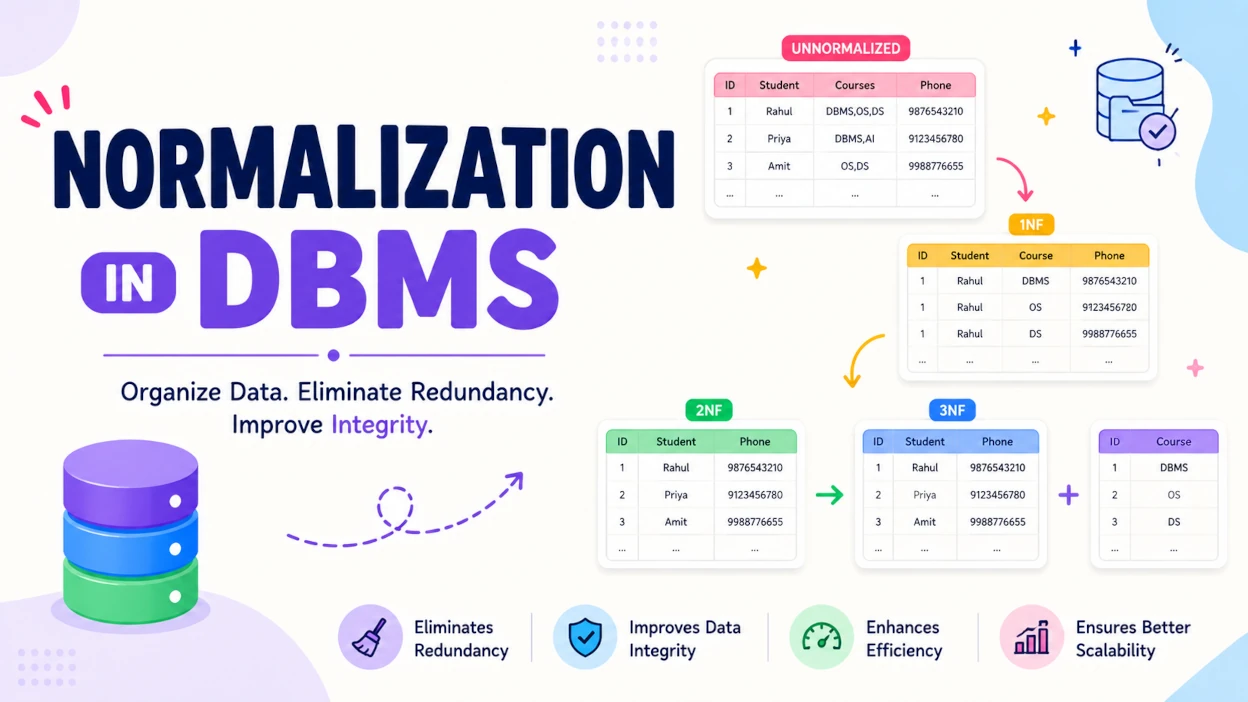
Normalization in DBMS Explained
Normalization is one of the highest-weightage topics in DBMS and appears regularly in IBPS SO IT Officer, SEBI Grade A IT, NIELIT, GATE, UGC NET, and technical interviews.
Many students try to memorize the normal forms. A better approach is to understand why normalization exists and which problem each normal form solves.
In this quick revision guide, we'll cover the complete concept of Normalization with examples, solved questions, shortcuts, and exam tips.
Practice DBMS Questions
Strengthen your DBMS concepts by solving free topic-wise mock tests for IBPS SO IT Officer.
Revise Functional Dependency Before Learning Normalization
Normalization is built on the concept of Functional Dependency. If you're not confident with determinants, partial dependency, and transitive dependency, spend 10 minutes revising Functional Dependencies first.
What is Normalization?
Normalization is the process of organizing data into multiple related tables to:
- Reduce data redundancy
- Eliminate anomalies
- Improve consistency
- Make database maintenance easier
The goal is not to create more tables, but to create a better database design.
Why Do We Need Normalization?
Suppose a table stores both student and course information.
| StudentID | Name | Course | Faculty |
|---|---|---|---|
| 101 | Rahul | DBMS | Dr. Sharma |
| 102 | Aman | DBMS | Dr. Sharma |
| 103 | Priya | OS | Dr. Mehta |
Notice that Faculty names are repeated multiple times.
This redundancy leads to problems.
Insertion Anomaly
You cannot add a new course until at least one student enrolls.
Update Anomaly
If the faculty changes, every row must be updated.
Missing even one row creates inconsistent data.
Deletion Anomaly
Deleting the last student enrolled in a course also deletes the course information.
Normalization removes these anomalies.
Remember: Normalization solves anomalies caused by data redundancy.

Normal Forms
The normal forms are applied sequentially.
UNF
 ↓
1NF
 ↓
2NF
 ↓
3NF
 ↓
BCNF
Each normal form removes a specific problem.
First Normal Form (1NF)
A table is in 1NF if:
- Every column contains atomic values.
- No repeating groups exist.
Not in 1NF
| Student | Subjects |
|---|---|
| Rahul | DBMS, OS, CN |
The Subjects column contains multiple values.
Convert to 1NF
| Student | Subject |
|---|---|
| Rahul | DBMS |
| Rahul | OS |
| Rahul | CN |
Exam Shortcut
1NF = Atomic Values
Second Normal Form (2NF)
A relation is in 2NF if:
- It is already in 1NF.
- It has no Partial Dependency.
Partial Dependency occurs when a non-key attribute depends on only part of a composite key.
Example
Composite Key
(StudentID, CourseID)
Table
| StudentID | CourseID | StudentName |
|---|
Dependency
StudentID → StudentName
StudentName depends only on StudentID.
This is a Partial Dependency.
Split the table into:
Student
| StudentID | StudentName |
Enrollment
| StudentID | CourseID |
Now the relation satisfies 2NF.
Exam Shortcut
2NF = Remove Partial Dependency
Third Normal Form (3NF)
A relation is in 3NF if:
- It is already in 2NF.
- It has no Transitive Dependency.
Example
StudentID → DepartmentID

DepartmentID → DepartmentName
Therefore
StudentID → DepartmentName
DepartmentName depends indirectly on StudentID.
Separate the Department table.
Now the relation satisfies 3NF.
Exam Shortcut
3NF = Remove Transitive Dependency
Boyce-Codd Normal Form (BCNF)
BCNF is a stronger version of 3NF.
A relation is in BCNF if:
Every determinant is a Candidate Key.
Although every BCNF relation is in 3NF, the reverse is not always true.
Competitive exams usually ask conceptual questions rather than complex BCNF decompositions.
Summary of Normal Forms
| Normal Form | Removes |
|---|---|
| 1NF | Repeating groups |
| 2NF | Partial Dependency |
| 3NF | Transitive Dependency |
| BCNF | Non-candidate key determinants |
This table alone can solve many MCQs.
Solved Example
Consider the relation
Student(
StudentID,
StudentName,
CourseID,
CourseName,
Faculty
)
Functional Dependencies
StudentID → StudentName

CourseID → CourseName, Faculty
Question:
Which Normal Form is violated?
Solution
CourseName and Faculty depend on CourseID rather than the complete key.
This creates Partial Dependency.
Therefore,
The relation violates 2NF.
Previous Year Style MCQ
Which Normal Form removes Transitive Dependency?
A. 1NF
B. 2NF
C. 3NF
D. BCNF
Answer
✅ C. Third Normal Form (3NF)
Memory Trick
Remember the sequence:
1NF
↓

Atomic Values

↓

2NF

↓

Remove Partial Dependency

↓

3NF

↓

Remove Transitive Dependency

↓

BCNF

↓

Every Determinant must be a Candidate Key
This flow is extremely useful during revision.
Common Exam Mistakes
Students often confuse:
- Partial Dependency with Transitive Dependency
- Candidate Key with Primary Key
- 3NF with BCNF
- Atomic values with uniqueness
Remember:
- 1NF deals with data format.
- 2NF deals with composite keys.
- 3NF deals with indirect dependencies.
- BCNF deals with determinants.
Quick Revision Table
| Normal Form | Easy Memory Rule |
|---|---|
| 1NF | One value per cell |
| 2NF | No Partial Dependency |
| 3NF | No Transitive Dependency |
| BCNF | Every determinant is a Candidate Key |
Practice Mock Tests
Now that you've revised Normalization, strengthen your understanding with topic-wise DBMS practice tests.
Continue Your DBMS Revision
Preparing for IBPS SO IT Officer, SEBI Grade A IT, or NIELIT? Explore these quick revision guides to strengthen your DBMS concepts.
- Functional Dependency in DBMS → Foundation of Normalization.
- DBMS Keys Explained → Types of Keys with examples.
- SQL Aggregate Functions → COUNT(), SUM(), AVG(), MIN(), MAX().
- SQL Joins Explained → All Joins with examples.
- SQL Constraints → Unique, Check, etc.
- SQL Commands → DDL, DML, DCL, DQL, etc.
Final Thoughts
Normalization is much easier to remember when you focus on the problem each normal form solves instead of memorizing definitions. Start with Functional Dependencies, understand why anomalies occur, and then learn how each normal form progressively removes them.
For competitive exams like IBPS SO IT Officer, SEBI Grade A IT, and NIELIT, mastering 1NF, 2NF, 3NF, and BCNF is usually sufficient to answer almost every Normalization question.